Author Archives: daria

Concert with the Munich Philharmonic

Anne Schwanewilms on TV: Saturday, 19.09., at 20.15 hours, 3sat will broadcast Gergiev’s premiere concert with the Munich Philharmonic. Anne will sing the soprano solo in Gustav Mahler‘s Sinfonie Nr. 2 c-Moll. The concert is also on livestream and will be available for seven days.

read more

The Sunday, morning performance (20.09., 11 h), of the same concert will be broadcast live on Bayerischer Rundfunk (BR Klassik).

read more

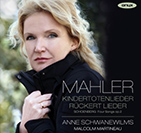
CD – Mahler’s Kindertotenlieder

Anne Schwanewilms places Mahler’s Kindertotenlieder  where music goes beyond music. She describes the five-part song-cycle as five stages of grieving, in which a whole world of emotion – from sorrow to disbelief, from horror to rage – is contained. The 25-minute farewell becomes an intimate dialogue with her accompanist Malcolm Martineau, in which voice and piano complement each other in diffidence and searching. The sheer speechlessness becomes sound that leaves the listener dumb.
 
The piano version takes us close to the elusive heart of Mahler’s emotional world. Without the glamorous colours and pain-easing detail of the orchestral transcription, we have here the very essence of the grief itself. This is ideal for a singer like Schwanewilms, who has never feared to show her own vulnerability. The combination of vigour and fragility in ‘In diesem Wetter’, the maternal warmth in ‘Wenn dein Mütterlein’, the poetic unearthliness in ‘Nun will sie Sonn’ so hell aufgeh’n ‘– allow a more complete interpretation of the Kindertotenlieder than seemed conceivable.
 
The Rückert Lieder also make perfect territory for the emotional depths that Schwanewilms invariably explores. The religious ecstasy of ‘Um Mitternacht’ is  beyond praise, and ‘Ich bin der Welt abhanden bekommen’ creates a moment when time and existence itself seem to stop. Martineau senses and complements the singer superbly. His own artistic approach, too, is never constrained, and his lyrical potential never exhausted. On the contrary, both allow him to paint a bold palette of feelings. ‘Liebst du um Schönheit’ is another undoubted  high point. The lighter, Des Knaben Wunderhorn songs, like ‘Scheiden und Meiden’, find Schwanewilms less effulgent, although here, too, the duo command Mahler’s lusty characterisations exceptionally well.  This recital sets a benchmark in Mahler recordings for many years to come.
 
As prologue to Mahler’s manifold vision of heartfelt sorrow, Schwanewilms chooses Schoenberg’s Opus 2. She fills this rather mystical template with an enigmatic singing, while Martineau supports her with the tact  he has to his finger-tips. The partnership  begins with an unusually intense ‘Erwartung’ and delivers a musical revelation…

Jan-Jakob Delanoye
© Cutting Edge – 2 augustus 2015

CD – Kindertotenlieder with Anne Schwanewilms

“Malcolm Martineau provides piano accompaniment of a variety and intimacy that suits the songs perfectly, perhaps more so than the usual orchestra version. Schwanewilms has lovely, floated high notes. She interprets with perception, and sings with heartbreaking purity.”

Fiona Maddocks, The Observer, London, July 26, 2015

Independent on Sunday – Mahler / Schönberg CD

4 **** (of 5) in the Independent on Sunday for the Mahler / Schönberg CD

“…the heartfelt performance by Anne Schwanewilms and meltingly beautiful accompaniment by Malcolm Martineau – just listen to that carefree song in the piano on Wenn dein Muetterlein   – make this compelling listening…”
 
Claudia Pritchard, Independent on Sunday, May 31st 2015

Grammy Nomination

The CD production of Strauss` Elektra conducted by Christian Thielemann, in which Anne Schwanewilms sings Chrysothemis, has been nominated for a Grammy award 2014 in the category "Best Opera Recording".

read more

Grammy Nomination 2014

The CD production of Strauss` Elektra conducted by Christian Thielemann, in which Anne Schwanewilms sings Chrysothemis, has been nominated for a Grammy award 2014 in the category "Best Opera Recording".


‘How to sing Kindertotenlieder without your voice choking up with anger and pain’

Anne Schwanewilms on her approach to the song cycle

For a long time I had a conflicted relationship with Mahler’s Kindertotenlieder. I wondered how it was possible to express in song the death of one’s own children and the pain associated with such an event. Would I be up to the task? Is it even something I want to do? How can I convey these powerful feelings of sorrow and rage without my voice choking up? Awareness of the historical context of the work only adds to these feelings – Friedrich Rückert’s children Luise and Ernst died in quick succession in the winter of 1833–4. In the wake of his loss Rückert wrote 428 poems on the death of children – a number that gives an idea of the depth of his sorrow. Like Rückert, Gustav Mahler’s acquaintance with death was all too personal: six of his eleven siblings died in childhood. When his daughter Maria Anna died in 1907 at the age of four, Mahler had already composed the Kindertotenlieder, in 1901 and 1904.

The work of psychologists Elisabeth Kübler-Ross (1926–2004) and Peter Levine (born 1942) gave me a completely new perspective on these songs. They both analyse the processes of death and grieving, observing and describing the different phases in the process of dying and also identifying different stages in the grieving process. Their findings are used in bereavement counselling today. Kübler-Ross identifies five stages in dying (whose order is not fixed) and five stages of development in the process of achieving release in the bereaved.

I think Mahler was working through his own experience of bereavement in these songs, and I don’t think it’s a coincidence that he did so in five songs. In the sequence of the five Kindertotenlieder I detect five different stages of grief. The piano part and the vocal line have the relationship of an inner voice, corresponding to instinct, and an external voice that wrestles with reality and gradually comes to accept it.

The first phase of release is characterized by denial. In ‘Nun will die Sonn’ so hell aufgeh’n’ (‘Now the sun will rise again so bright’) Mahler uses the piano as an inner voice accompanying the grieving parent. It takes him – or her – tenderly by the hand and tries to turn him towards reality, to tell him that the news of the child’s death is real. But the bereaved parent refuses to face up to this truth, seeking to deflect from it with descriptions of nature.

The song ‘Nun seh’ ich wohl, warum so dunkle Flammen’ (‘Now I see why you flashed such dark flames’) reflects the stage at which the mourner is experiencing feelings of anger and rage. The parent has gradually come to understand the truth – despite occasional regressions into denial – and this understanding gives rise to fury and outrage. The inner voice – the piano – reveals both rage and doubt, but compared with the first stage no longer has to play the role of a cautious escort.

In the third song, ‘Wenn dein Mütterlein tritt zur Tür herein’ (‘When your mother dear steps inside the door’) – or, so to speak, in the third stage – the mourner is ambivalent: on the one hand there is a dreamlike transposition to a context in which the child was still alive – a memory of the past despite the full awareness that it has gone. At the same time, at the moment when consciousness dawns, the parent is assailed by grief again: the piano, or inner voice, is entirely in step with the bereaved narrator and can distinguish between dreams and reality.

In the fourth, depressive stage the grieving parent, wide awake and therefore fully conscious, recalls the past, when the child was still alive – ‘Oft denk’ ich, sie sind nur ausgegangen’ (‘Often I think they have only gone out’). He thinks back to a real occurrence, namely the time when the child was once late coming home. At the same time the inner voice represented by the piano leaves no room for doubt that this event is very much in the past, and the words ‘Wir holen sie ein auf jenen Höh’n’ (‘We’ll catch them up on those hills’) are there to comfort – albeit that this comfort is called into question once again at the end of the song, by means of repetition of the text and the dynamic climax in the piano part.

In ‘In diesem Wetter, in diesem Braus’ (‘In this weather, in this storm’) we reach the fifth and final stage:
acceptance. The bereaved narrator acknowledges what has happened and appreciates the situation in a concrete sense: he can now give free rein to his resentment, anger and guilt. First the piano formulates the desire for peace, then the grieving parent switches to a peaceful melody, to the very same words that he was earlier shouting out in rage – a kind of peace, albeit perhaps a temporary one.

Rückert sought in his poems to find solace and understand his fate. Mahler follows his path in the process of the personal, tortuous journey from the grief of the opening of the first song, in D minor, to the D major of the fifth song. In this final song he quotes the theme of the finale from his Third Symphony, headed in the score with the words ‘What love tells me’. For Mahler as well as for Rückert, love was more powerful than death, and it is in this sentiment that the musical and psychological interpretation of text and music coincide: it is this that has formed the basis of my own reading of these Kindertotenlieder.

Anne Schwanewilms
Translation: Saul Lipetz

(From the CD Booklet – Mahler & Schoenberg, Onyx 2015)

New Release CD: Songs from Mahler and Schoenberg

Anne Schwanewilms new CD with "Kindertotenlieder", songs from "Des Knaben Wunderhorn" and "Rückert-Lieder“ von Gustav Mahler, and "Lieder op.2" from Arnold Schoenberg.

Listen now

read more

Strauss Concert | Monte Carlo | May 3th

[In the closing scene of Strauss’s Capriccio], the German soprano Anne Schwanewilms displays a magnificent voice, with very refined even gleaming inflections. The final sections attained the very heights of luminosity. 

In the second half of the concert, her execution of “Morgen!”, opus 27, “Die Nacht”, opus 10 and “Zueignung”, opus 10 offer even more opportunities to one of the leading interpreters of the Richard Strauss repertoire. She handles the high pitched notes like fragile pieces of lace, bringing an extreme vocal delicacy to the point and brilliance of the theme.

Jean-Luc Vannier, Monaco, May 4th 2015, www.musicologie.org

„Singing like a garden of flowers“ – Article in the magazine Classica

„To begin. She delayed her career for a few years, she wanted to be a landscape gardener. Anne Schwanewilms is no doubt the only singer who will give you the latin names…“

read more