
Grammy Nomination
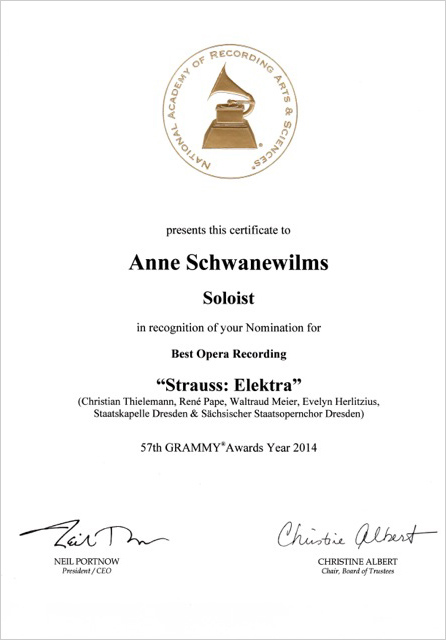
The CD production of Strauss` Elektra conducted by Christian Thielemann, in which Anne Schwanewilms sings Chrysothemis, has been nominated for a Grammy award 2014 in the category "Best Opera Recording".

The CD production of Strauss` Elektra conducted by Christian Thielemann, in which Anne Schwanewilms sings Chrysothemis, has been nominated for a Grammy award 2014 in the category "Best Opera Recording".
The CD production of Strauss` Elektra conducted by Christian Thielemann, in which Anne Schwanewilms sings Chrysothemis, has been nominated for a Grammy award 2014 in the category "Best Opera Recording".
Anne Schwanewilms on her approach to the song cycle
For a long time I had a conflicted relationship with Mahler’s Kindertotenlieder. I wondered how it was possible to express in song the death of one’s own children and the pain associated with such an event. Would I be up to the task? Is it even something I want to do? How can I convey these powerful feelings of sorrow and rage without my voice choking up? Awareness of the historical context of the work only adds to these feelings – Friedrich Rückert’s children Luise and Ernst died in quick succession in the winter of 1833–4. In the wake of his loss Rückert wrote 428 poems on the death of children – a number that gives an idea of the depth of his sorrow. Like Rückert, Gustav Mahler’s acquaintance with death was all too personal: six of his eleven siblings died in childhood. When his daughter Maria Anna died in 1907 at the age of four, Mahler had already composed the Kindertotenlieder, in 1901 and 1904.
The work of psychologists Elisabeth Kübler-Ross (1926–2004) and Peter Levine (born 1942) gave me a completely new perspective on these songs. They both analyse the processes of death and grieving, observing and describing the different phases in the process of dying and also identifying different stages in the grieving process. Their findings are used in bereavement counselling today. Kübler-Ross identifies five stages in dying (whose order is not fixed) and five stages of development in the process of achieving release in the bereaved.
I think Mahler was working through his own experience of bereavement in these songs, and I don’t think it’s a coincidence that he did so in five songs. In the sequence of the five Kindertotenlieder I detect five different stages of grief. The piano part and the vocal line have the relationship of an inner voice, corresponding to instinct, and an external voice that wrestles with reality and gradually comes to accept it.
The first phase of release is characterized by denial. In ‘Nun will die Sonn’ so hell aufgeh’n’ (‘Now the sun will rise again so bright’) Mahler uses the piano as an inner voice accompanying the grieving parent. It takes him – or her – tenderly by the hand and tries to turn him towards reality, to tell him that the news of the child’s death is real. But the bereaved parent refuses to face up to this truth, seeking to deflect from it with descriptions of nature.
The song ‘Nun seh’ ich wohl, warum so dunkle Flammen’ (‘Now I see why you flashed such dark flames’) reflects the stage at which the mourner is experiencing feelings of anger and rage. The parent has gradually come to understand the truth – despite occasional regressions into denial – and this understanding gives rise to fury and outrage. The inner voice – the piano – reveals both rage and doubt, but compared with the first stage no longer has to play the role of a cautious escort.
In the third song, ‘Wenn dein Mütterlein tritt zur Tür herein’ (‘When your mother dear steps inside the door’) – or, so to speak, in the third stage – the mourner is ambivalent: on the one hand there is a dreamlike transposition to a context in which the child was still alive – a memory of the past despite the full awareness that it has gone. At the same time, at the moment when consciousness dawns, the parent is assailed by grief again: the piano, or inner voice, is entirely in step with the bereaved narrator and can distinguish between dreams and reality.
In the fourth, depressive stage the grieving parent, wide awake and therefore fully conscious, recalls the past, when the child was still alive – ‘Oft denk’ ich, sie sind nur ausgegangen’ (‘Often I think they have only gone out’). He thinks back to a real occurrence, namely the time when the child was once late coming home. At the same time the inner voice represented by the piano leaves no room for doubt that this event is very much in the past, and the words ‘Wir holen sie ein auf jenen Höh’n’ (‘We’ll catch them up on those hills’) are there to comfort – albeit that this comfort is called into question once again at the end of the song, by means of repetition of the text and the dynamic climax in the piano part.
In ‘In diesem Wetter, in diesem Braus’ (‘In this weather, in this storm’) we reach the fifth and final stage:
acceptance. The bereaved narrator acknowledges what has happened and appreciates the situation in a concrete sense: he can now give free rein to his resentment, anger and guilt. First the piano formulates the desire for peace, then the grieving parent switches to a peaceful melody, to the very same words that he was earlier shouting out in rage – a kind of peace, albeit perhaps a temporary one.
Rückert sought in his poems to find solace and understand his fate. Mahler follows his path in the process of the personal, tortuous journey from the grief of the opening of the first song, in D minor, to the D major of the fifth song. In this final song he quotes the theme of the finale from his Third Symphony, headed in the score with the words ‘What love tells me’. For Mahler as well as for Rückert, love was more powerful than death, and it is in this sentiment that the musical and psychological interpretation of text and music coincide: it is this that has formed the basis of my own reading of these Kindertotenlieder.
Anne Schwanewilms
Translation: Saul Lipetz
(From the CD Booklet – Mahler & Schoenberg, Onyx 2015)
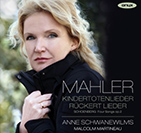
Anne Schwanewilms new CD with "Kindertotenlieder", songs from "Des Knaben Wunderhorn" and "Rückert-Lieder“ von Gustav Mahler, and "Lieder op.2" from Arnold Schoenberg.
[In the closing scene of Strauss’s Capriccio], the German soprano Anne Schwanewilms displays a magnificent voice, with very refined even gleaming inflections. The final sections attained the very heights of luminosity.
In the second half of the concert, her execution of “Morgen!”, opus 27, “Die Nacht”, opus 10 and “Zueignung”, opus 10 offer even more opportunities to one of the leading interpreters of the Richard Strauss repertoire. She handles the high pitched notes like fragile pieces of lace, bringing an extreme vocal delicacy to the point and brilliance of the theme.
Jean-Luc Vannier, Monaco, May 4th 2015, www.musicologie.org

„To begin. She delayed her career for a few years, she wanted to be a landscape gardener. Anne Schwanewilms is no doubt the only singer who will give you the latin names…“
Tribute by André Tubeuf
Anne Schwanewilms
Singing like a garden of flowers. The German soprano first studied horticulture ! She has built a model career (Strauss, Wagner)
To begin. She delayed her career for a few years, she wanted to be a landscape gardener. Anne Schwanewilms is no doubt the only singer who will give you the latin names of the flowers in the bouquet presented at the end of a recital. Singing prevailed over horticulture, but, for once, the secret garden of a singer is truly her own garden. Hers slopes down to the river. From its flowers she has taken the shades, the nuances of light and shade in her art of expression (in French as well: Debussy). But it is something altogether sensuous and rare which goes to your head, a whole bouquet, pleasure and almost intoxication of perfumes when in ‘Ich atmet einen linden Duft’ of Mahler’s Rückert Lieder she enumerates the variations of the lime tree, this sweetness of taste of delicate lime blossom. Entrancing and charming!
She has a little of the Lorelei in her own self, her golden hair draped over her shoulders. Being of another world, which Schumann might have set to music.
Her beginnings were obviously safe. Only her spoken voice, deep and warm (but never harsh) reminds you that she started as an alto. In the church choirs, child and adolescent she sang everything which was low from Bach passions to Delilah but once she had chosen the theatre, it was towards the mezzo then Wagner as if naturally that this great golden haired lady was guided, so that one might say put on this earth for the Weiala of Wellgunde in the Rheingold. She quickly became Gutrune at Bayreuth and, in the german country, Elsa or Elizabeth the Wagnerian flaxen haired maidens. From where, more unwisely Senta. And why not Brünnhilde soon?
An instinct within her has reared up. Her voice was originally low from the beginning (and her feet on the ground, firm with roots like flowers) . But her singing, also golden, rises at the summons of light and unfolds acutely, elegaically and lyrically. She did not have as of right her portion of pages and cherubs at her early beginnings like others, much harder for her. So, already having achieved the hochdramatische, she will never go back. On her path has come the right alternative. A youthful Fidelio, a Euryanthe of moon and milk at Glyndebourne. And from there, all that is late romantic in music and singing and first of all a rediscovery of Schreker.
Her twofold break was ‘Der Ferne Klang’ in Berlin and ‘die Gezeichneten, the major event for her in Salzburg 2005. At the same time she sparkled in Strauss, a poetic marriage between music and words with nuances and semi shades, a sort of perpetual delectation of mixed harmonies (like Schwarzkopf with whom she has more than a garden in common). Her Arabella, her Marschallin have a studded sweetness in their vocal sensitivity and refinement which is unique nowadays, and more so with the Empress something both voluptuous yet chastely luminous which hovers, not of this world , then escapes magically.
Such a complete scenic incarnation would no doubt be impossible without a passionate exploration (and laborious, a true labour of gardening) of the landscapes of german lieder. It was with Hugo Wolf that she first found happiness naturally, in the marriage fusioned between notes and words, this school of modulation. As if born and innate from these, proceed to Schumann. Eichendorff rather than Heine gave the keys to her alone – you need only listen to her Mondnacht.
Her own Landscape.
But how to proceed from this complexity which for her is so simple, to return to Schubert, in his way quite innocent and at times primitive to be on Earth, to sing directly and thickly. She is still looking for her own landscapes which will come soon.In the meantime she has little difficulty in seeking the more subtle and sensuous of Debussy in his ‘Proses Lyriques’. More vaults…
Having not followed the normal channels and with fewer appearances in the theatre, now only is she asserting her claim to and obtaining what at first was not given to her. Roles where you blossom in the pure and simple lyrical pleasures of singing. Almost snorting like a horse at expectations, it is not Isolde but Hanna Glawari from ‘The Merry Widow’ which is finally coming to her at an age when others prefer to forget that they can no longer do it, and tomorrow Rosalinde in the ‘Bat and Ball’. As Marguerite in ‘Faust’, she will see herself receive the bouquet from the hands of Siebel and in ‘The Damnation’, her baptism into Berlioz. She likes French for the vowels, the shading, the modulations. A Dido is maturing in her when the richest September flowering will blossom.
She follows her own path like no-one else. She likes neither planes nor crossing oceans. She prefers the train, to have her world around her, her husband, the recital pianist (with his own family); a complete cocoon at the heart of which the singing is resplendent and blossoms better ( and in autumn this will be more succulent again.).
Her career moves at its own pace, or rather, does not seek to be a career. Nowadays there is nothing rarer. But there is still no better recipe either. From where does the unique Schwanewilms hallmark emanate every evening? At one moment cosy and intimate like the fireside with an elder sister who is a little fay. But what elixirs as well! What rare flavours, for the most jealous of gourmets.
A.T
Translated loosely
G C W
7/4/15
(Classica /Frankreich No 171, April 2015)
With the “Orchestre Philharmonique de Monte-Carlo“ and conductor Jeffrey Tate. Auditorium Rainier III, Monte Carlo.
Program: 4 Interludes orchestraux d`Íntermezzo op.72, Capriccio: Final Scene, break, Strauss songs: Morgen – Die Nacht – Zueignung, Tod und Verklärung op 24
Because of a protracted illness (bronchitis) Anne Schwanewilms will not be singing the premiere performance of Elektra (29.3.2015). She is expected to sing the performances from the 1st of April.

Anne Schwanewilms was interviewed by Dr. Gernot Zimmermann for the programme "Intermezzo – Artists in Conversation“.